Showing posts with label black pearl. Show all posts

Monday, 28 July 2014

Endless summer

Whilst there's plenty more work to be done in the garden the greenhouse is settling in nicely
There's plenty foliage inside. The drip feeders for the Root Pouches can seen on top of the pots.
The habaneros to the right are producing good sturdy stems.
Sweet Banana
Some of these were the seedlings I damaged with the soap, it's good to see they've recovered.
Padrons collected from Galicia.
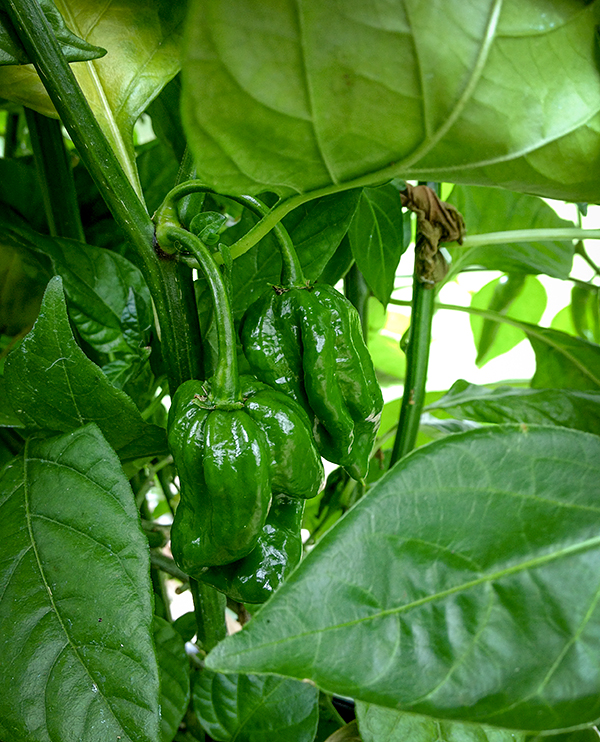
Black Pearl
The beautiful variegated leaves of Orozco
Superchilli
Lots of fruit on the Cheyenne plant.
Black Tongued Scorpion
Nepalese Snakebite

Thursday, 26 June 2014

June greenhouse photos

Asides from a few chillies developing on the Cheyenne, there's been no major developments this week, just plenty of growth and a steady stream of aphids to kill.


Random chillies on the nursery table including Superchilli & Black Pearl
Chillies, melons and even a Christmas poinsettia on the nursery table
Not much top-growth from the seedlings but plenty of roots developing below

Sunday, 29 December 2013

A new season

It's that time of year again, time to start thinking about the new season and what to plant.
The hotter varieties, such as Habanneros can be quite slow growing and therefore benefit from a longer season. 

With the addition of the new grow room and a heated propagator it's the perfect excuse to make an early start to the season.  I've chosen a variety of sees this year to give me a crop for all occasions.

1. Chocolate Habanero - Very hot and full of flavour, I first grew these a few years back and although the plants flourished, they bore no fruit (except for the plants that I gave away). Determined not to be beaten, I'm given them a second try.

2. Yellow Seven Pot Habanero. This year's volcanic choice. Superhot and flavoursome, I'm looking forward to growing these gnarly pods.

3. Pimentos de Padron. I collected these seeds from our family that we visited in Galicia in northern Spain earlier this year, within just a few miles of the town of Padron itself. These randomly spicy tapas peppers are delicious when fried in olive oil and liberally scattered in salt.

4. Black Tongued Scorpion. A new one for me, these chillies resemble black scotch bonnets but with less heat. How could I possibly resist a chilli with a name like a death metal band.

5. Joe's Long Cayenne. This is our chilli challenge for this year so I felt it prudent to plant a few extra seeds for those who join the challenge late.


For planting I used a mixture of a sifted potting compost and plenty of vermiculite. Hopefully this light mix should promote good healthy roots and make the seedlings easy to pot on into a hydroponic system should I choose to do so. Here the planted seed trays are floated in water to dampen the compost. Using this technique rather than watering the compost is less likely to over-compact it.


Once soaked the trays were topped with vermiculite and placed in the heated propagator. This propagator isn't thermostat controlled I've added a thermometer so I can keep track on the temperature. For germination 25-28 C is ideal, once the seeds start sprouting then the temperature can be dropped a little. 


The heater in the chilli room is working well, rigged up to a thermostat it's keeping a steady temperature as shown by this maximum and minimum thermometer which has barely wavered in the month it's been running.


Despite the relatively low temperatures and the limited artificial light, the chillies that I've overwintered are not only coping but positively thriving. The Aji Lemon Drop that grew so prolifically during the summer has refused to stop and despite the severe haircut I gave it, is throwing out new growth already. I've cut back on the hours of light they're receiving to ensure that they're not too monstrous by the time spring comes. 

Sunday, 15 September 2013

Home Again...

Well I deserted the chilli plants for two weeks and fled to the sunnier climes of Spain. More specifically the Northwest region of Galicia, home to the town of Padron.

Pimientos de Padron can be found in most tapas bars in the area, a plate full of these small green chillies is fried in olive oil and generously seasoned with salt.  Although predominantly sweet, a percentage of these peppers are hot enough to cause alarm.  The percentage tends to vary from batch to batch and although some claim it's about 10%, I must admit that in my (fairly extensive) investigations it was more like 5%.
Pimientos de Padron
However, one batch prepared by an aunt, contained a red one that literally took my breath away and left me gasping and nearly speechless for a good five minutes.  That'll teach me to be complacent! 

I made sure to collect some seed from her chillies and will be growing them on next year.

Upon my return I visited the chillies that I'd relocated to my parents' garden to see how they had fared in my absence.

Red Scotch Bonnet
Yellow Scotch Bonnet

Squat Frog
Most of the plants are dripping with fruit although we'll need some more sunshine to get the fruit to ripen. Somewhat disappointingly, both Dorset Nagas are devoid of large fruit although there are a few small ones forming. Whether they'll get to a decent size and ripen in this somewhat dismal weather is open to debate.

Loco

Black Pearl
The Chilligrows are proving their worth with the plants within growing to impressive sizes, their branches bending under the weight of the fruit.

The Chilligrows in the greenhouse

Paper Lantern Hab

Paper Lantern Hab

Trinidad Scorpion

Superchilli

Friar's Hat

The hydroponic unit is working overtime

And there's plenty of fruit to show for all the growth. This is the Orange Magnum Habanero

L to R: Joe's Long & Friar's Hat

Joe's Long

Naga Jolokia

Fruit Brust Habanero
I suspect that I'll need to come up with some new recipes to use up what promises to be a bumper crop of chillies.  All we need is a week or so of sunshine to get the fruit ripening before the growing season comes to an end.

Monday, 19 August 2013

Exodus

Due to work commencing on the garden it was decided to move the chilli collection en-mass to a new location (namely my long-suffering parents' garden).

I've been frantically giving away as many plants as I could to reduce the number to relocate so by the time the exodus was upon us I was down to a mere(!) 50 or so plants.

They were duly crated up and loaded into the car for the short hop to pastures new.  Likewise, the various chilli houses were disassembled and, with the aid of a trailer, reunited with the plants.

One of the two Chilligrows L-R; Friar's Hat, Lemon Drop, Superchilli
The plants in the Chilligrows were the hardest to transport, the plants having grown massively (despite frequent and ruthless pruning) and were laden with fruit and flowers that I was keen to avoid damaging.

The roots of this Lemon Drop have escaped into the reservoir below

In the departure lounge - the first batch ready to be moved.

A Trinidad Scorpion with a perfectly formed 'stinger'

The mighty Scotch Bonnet plant is doing exceptionally well in the Root-Pouch.

Plenty of Habaneros in their temporary greenhouse home

These were supposed to be De Arbol seeds but I'm beginning to have my doubts.

The pretty (and bountiful) Black Pearl

Etna is laden with small glossy pods waiting to ripen

Capa Conic

The Chilligrows in their new home L to R: Paper Lantern, 2 x Scorpion, Lemon Drop, Superchilli & Friar's Hat

Plenty of hot fruit forming on the Paper Lantern Habanero

Joe's Long Chilli
As for the hydroponic experiment, well it got off to a slow start when I realised that I'd only mixed the nutrients to a third of the desired strength.  However, the plants have been busy catching up with their soil-based companions and have finally overtaken them.

Both plants now have plenty of flowers and the Orange Hab also has fruit forming.  The plants seem very healthy with plenty of foliage.  I'll probably have to provide them with some support before too long as the clay pellets don't support the stems and roots as well as the much denser soil does.

L to R: Peach Habanero, Orange Magnum Habanero